Lead Service Lines in Texas: Looking Up What’s on File for Your Home
A lead service line record can be hard to find—and even harder to interpret when the utility lists only part of the pipe or marks a material as unknown. Here’s how to locate the inventory for a Texas home, check both sides of the service line, understand what the record can and can’t tell you, and ask the utility for clarification.
What a Texas service line inventory can tell you
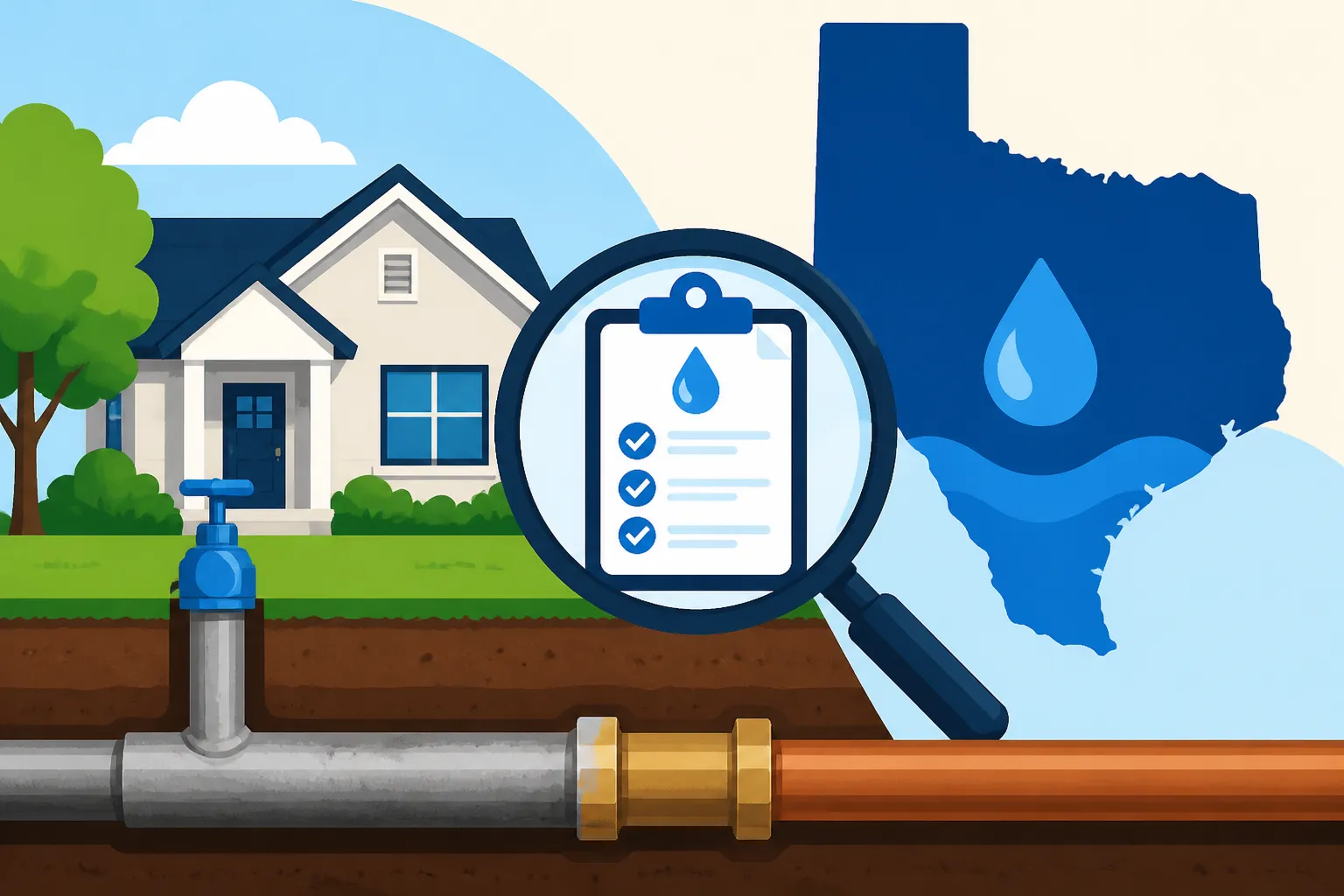
A service line is the pipe connecting a water system’s main to a property. Depending on where ownership changes, the section between the main and the meter may belong to the water system, while the section from the meter toward the building may be the customer’s responsibility. The dividing point and ownership arrangement can vary, so don’t assume that a line is all utility-owned or all customer-owned.
A service line inventory is a record of what the water system has on file about service-line materials. It can help you find out whether the system has identified a lead service line, recorded an unknown material, or listed another material. It is not a laboratory test of your tap water, a complete record of every pipe inside your home, or a guarantee that all parts of the service line have been identified correctly.
The inventory is useful because lead can be associated with service-line materials as well as plumbing on the customer’s side of the meter. Even if a utility’s record does not identify a lead service line, older plumbing, fixtures, or other components may still be relevant to a home’s water. For more context on those separate sources, see No Lead Service Line Doesn’t Mean No Lead: Texas Plumbing Risks.
An inventory entry also needs to be read in context. If the system and customer portions are recorded separately, one side may have a known material while the other is unknown. An overall label may not show that distinction. Checking the separate entries is a better starting point than relying on a broad summary or an address-level color on a map.
The inventory can help answer questions such as:
- Does the utility have a record for this service address?
- Is the system-owned portion identified separately from the customer-owned portion?
- Does either portion have a lead or unknown-status listing?
- What evidence or inspection method supports the material recorded?
- Is the record current, and how can you request a correction if it does not match what you observe?
It cannot, by itself, answer whether water at a particular faucet contains lead. The inventory describes pipe material on file, not a measured lead concentration at your tap. If you need a tap sample, see Getting Tap Water Tested for Lead in Texas: Labs and Utility Help. To understand how line records differ from the water-quality report, Texas Consumer Confidence Reports: A Homeowner’s Guide offers related background.
A record is best treated as a starting point for questions, not a final judgment about the water in a home. A listed material may be based on records or other information the utility has collected; an unknown entry means the material has not been confirmed in the record. Neither label should be stretched beyond what the utility’s documentation actually says.
How to find the inventory for your Texas address
Start with the water provider serving the property. If you are not sure which utility supplies the tap, use your water bill or look up the provider before searching. The article Who Supplies Your Water in Texas? How to Find Your Provider explains ways to identify the provider. If you rent, the landlord or property manager may know which account or utility serves the building, but you can also ask the utility directly; How Texas Renters Can Find the Utility Behind Their Tap covers that situation.
Once you know the provider, look for its service line inventory through the utility’s official website. Search for terms such as “service line inventory,” “lead service line,” “lead inventory,” or “lead pipes.” The inventory may be a searchable tool, a downloadable file, a map, or a page describing how to request the property record. A utility may use a contractor or a separate platform to host the search, so check that you are looking at the provider’s official inventory rather than an unrelated map or general database.
The Consumer Confidence Report, often called a CCR, is another place to start. According to the Texas Commission on Environmental Quality, The report must include a statement that a service line inventory has been prepared and instructions to access the service line inventory. According to the Texas Commission on Environmental Quality, if the inventory is online, the CCR must include the direct link to the inventory. Look in the report for the service-line section and follow its instructions. If the link is not obvious, use the utility’s own website to search for the inventory by name.
The Texas Commission on Environmental Quality says the initial Lead Service Line Inventory was due October 16, 2024. That deadline is useful context when you are checking whether a utility has made its inventory available, but it does not tell you what the record for your particular property says. Search the current utility materials and contact the provider if you cannot locate the address or understand the way the record is presented.
If your provider buys water from another system, that does not automatically make the wholesale supplier’s inventory the right record for your home. Start with the provider that bills or serves the property, then ask it to identify which system’s records cover the service line at your address. For more on which report applies when a utility purchases water, see Whose Test Results Apply When Your Texas Utility Buys Its Water?. Service-line ownership and inventory coverage are questions to ask the provider directly; do not assume that the entity treating or selling the water keeps the property-level record.
When searching, use the full service address as it appears on a utility bill, including the apartment or unit identifier when relevant. Check spelling, street suffixes, directional markers, and any alternate address format the utility may use. A search that returns no result does not necessarily mean there is no record. It could mean the address was entered differently, the inventory does not support address-level searching, or the provider needs to look up the record for you.
If the inventory is not available online, the CCR’s access instructions should help you work out how to request it. You can also contact the water utility through the contact details on its official website. Ask for the service-line inventory entry for the exact address, and request the entries for both the system-owned and customer-owned portions where ownership is split. If a call or web form does not resolve the question, keep a copy of your request and any response so you can refer to the same details in a follow-up.
Useful details to have ready include:
- The full service address, including the unit number if there is one.
- The name of the water provider shown on the bill.
- The inventory page or report you searched, if available.
- The exact wording or classification shown for the address.
- Whether the record appears to separate system-owned and customer-owned portions.
- A clear question about what information you need the utility to confirm.
Avoid sharing account or personal information in public comments or on unofficial sites. Use the provider’s official contact channels for a property-specific record. If the utility directs you to a separate inventory tool, confirm that the tool is the one the provider uses for its official service-line information.
How to read the record for your property
Search the inventory for the service address, then check the material entry for each side of the service line. According to the U.S. Environmental Protection Agency, material classifications for both the system- and customer-side where ownership is split should be considered. That means an overall address-level label may not be enough: look for separate fields, rows, map details, or notes for the system-owned portion and the customer-owned portion.
A useful way to organize what you find is to record each side independently:
| Inventory detail | What to look for | What to do if it is unclear |
|---|---|---|
| Service address | The exact property address or an address format that clearly matches it | Ask the utility to confirm the correct record |
| System-owned portion | A separate material entry or description for the utility side | Ask what pipe section the entry covers |
| Customer-owned portion | A separate material entry or description for the customer side | Ask whether the utility has information for the private side |
| Overall classification | A summary label for the service line or address | Do not treat it as a substitute for checking each side |
| Unknown status | A notation that the material has not been confirmed | Ask what is unknown and what information is available |
| Supporting detail | Notes about records, inspection, or other basis for the entry | Ask what the utility relied on and whether the record can be reviewed |
The labels and layout differ between inventories. Some systems may show distinct entries; others may present a single row, a map marker, or a summary. Do not assume a particular color or abbreviation has the same meaning across providers. Use the legend and definitions supplied with that inventory, and ask the utility to explain any term that is not defined.
Pay attention to the difference between “unknown” and “lead.” Unknown does not establish that a pipe is lead, but it also does not establish that the pipe is made of a non-lead material. It means the material is unresolved in the record. Likewise, a record that identifies a material for one side does not automatically answer what is present on the other side.
If you find a general label such as “non-lead” or a broad summary that appears reassuring, check whether the inventory actually describes both sides. The U.S. Environmental Protection Agency’s guidance calls for material classifications for both the system- and customer-side where ownership is split. If the display does not let you see those separately, ask the utility whether the record includes both portions and what each entry says.
Check whether the address match is exact. A record for a nearby property is not evidence about your service line, even if the houses look similar or share a street segment. In multi-unit buildings, the inventory may be organized by building address, service connection, or another format. Ask the utility how the record maps to your unit and whether there is a separate service line for the building or unit.
It can also help to save the inventory entry or write down its details while you review it. Note the date you accessed the record, the address searched, the classification shown for each side, and any explanation provided by the utility. This gives you a precise reference if the provider later clarifies or updates the record. It also helps prevent a summary label from being mistaken for a more detailed finding.
If the record is not clear, ask focused questions rather than asking only whether the home “has lead pipes.” For example, ask whether the utility’s entry describes the system-owned side, the customer-owned side, or both. Ask what length or section of pipe the entry covers, whether the classification is confirmed or unknown, and what the utility means by its exact label. Use the provider’s terminology in your question so its response can be tied to the record you are viewing.
For more help interpreting who owns which part of a line, see Reading the Utility and Customer Sides of a Texas Service Line Record. You may also find What Unknown Lines on a Texas Inventory Say About the Whole System useful if one or both sides are listed as unknown.
What the inventory does and does not establish
A service-line inventory is about the pipe material the utility has documented. It does not certify every pipe, solder joint, fixture, or plumbing component inside a home. The pipe from the meter to the building may be recorded as customer-owned, but the service line is not necessarily the only part of a property’s plumbing worth considering.
A line can also have different materials along its length. A record that describes one portion may not cover every segment, and a brief inventory label may not explain how the material was determined. If your record appears incomplete, ask the utility whether it has supporting notes, inspection information, or a process for correcting the entry. The utility can explain what its record covers; avoid interpreting a short label as proof of details the record does not show.
A “no lead identified” result should not be treated as a tap-water test. The service-line inventory and a water sample answer different questions. The inventory concerns pipe material on file; a sample measures water from the location and time it was collected. Neither one automatically substitutes for the other. For help understanding the limits of system-wide reporting compared with results from a home tap, see Does the CCR Test the Water at Your Own Kitchen Tap in Texas?.
Similarly, a lead or unknown entry does not by itself tell you the level of lead in water at a faucet. If you have questions about possible health effects, contact your local health department or a medical professional. For property-specific sampling options, ask the utility whether it offers assistance or consult a qualified laboratory. City Pipe, Home Plumbing or the Water Itself? Pinpointing Texas Lead discusses how different potential sources can be considered.
Be careful with generalized statements about a neighborhood. A nearby house’s record may be different because service connections and plumbing histories differ. An inventory map can be a useful way to see the provider’s records across an area, but it is not a substitute for checking your own service address and both portions of your line.
The inventory may also change as the utility obtains more information. If the provider confirms that an entry is unknown, ask whether it has a process for collecting additional information or updating the record. Do not assume that an online entry has been recently inspected simply because it is visible. Ask what the utility can say about how the classification was assigned and whether it can confirm the current status for the property.
This is why “what is on file” is an important phrase. The inventory reports what the utility has recorded, not necessarily everything that can be established through a separate inspection or test. If what you can see at the property appears inconsistent with the entry, document the discrepancy and ask the provider how to have it reviewed. If you are a tenant, you can still ask the utility about the service record and raise property-access or plumbing concerns with the landlord.
Related records can help provide context, but each has a different purpose. A CCR summarizes water-quality information and includes access instructions for the service-line inventory. A lead service-line inventory is not a full plumbing map of the home, and a tap sample is not a material inventory. Keeping these distinctions clear helps you ask the right question of the right source.
What to do if the entry is missing, unknown, or seems wrong
If you cannot find your address, do not interpret a blank search result as proof that the service line is made of a particular material. First, try the address as it appears on the water bill and check for formatting variations. If the system uses a map or downloadable list, review its search instructions or contact the utility for help locating the correct record.
If the inventory does not show separate entries for the system-owned and customer-owned portions, ask the utility whether it maintains those classifications separately. The U.S. Environmental Protection Agency says to check material classifications for both sides where ownership is split. If you still cannot tell what the overall entry means, request the property-specific record and ask the utility to identify which pipe section it covers.
If the address is marked unknown, ask what is known and what remains unconfirmed. You can ask whether the unknown status applies to one side or both, what records or observations the utility has, and whether it can explain how the line was classified. Do not treat an unknown entry as a confirmation of lead or as confirmation that the pipe is not lead.
If the record appears inconsistent with information you have, send the utility a concise request for review. Include the address, the inventory entry you are questioning, and a description of the discrepancy. If you have a document or photo relevant to the service line, ask the utility how it wants that information submitted. Do not dig or disturb a service line based only on an online map or a general description; ask the provider what process applies before any physical inspection or work.
When you contact the utility, you might ask:
- Does this record match the exact service address?
- What material is recorded for the system-owned portion?
- What material is recorded for the customer-owned portion?
- Does an unknown entry apply to one portion or both?
- What does the inventory’s overall classification mean?
- What information was used to assign the material entries?
- Is there more detail available than what appears in the online display?
- How can I ask for the record to be reviewed or corrected?
- What should I do if I need a tap sample or a plumbing inspection?
Keep the request factual and specific. An open-ended question such as “Is my water safe?” may not produce an answer about the service-line record, because the inventory and water-quality testing are different matters. It is more useful to ask what the utility has on file for each side of the service line, then separately ask about available sampling or other assistance.
If the utility confirms an entry or offers an explanation, write down the response and any next steps it gives you. If the response does not answer which side of the line is being described, follow up with that distinction. If you are told to consult another office or contractor, ask which record or service that person can provide so you do not confuse an inspection, a repair estimate, and a water sample.
The line’s ownership boundary matters when planning any further investigation or work. A utility can clarify how its records describe the system side and customer side, while the property owner may need to address customer-owned plumbing. Do not assume who must inspect, repair, or replace a particular segment without confirming the provider’s ownership information and applicable arrangements. For questions about pipe records before a purchase, see Lead Service Line Questions Texas Home Buyers Should Ask the Seller.
If you are buying a home, ask the seller for any service-line records they have, then compare those details with the utility’s inventory. A seller’s information and the provider’s record may not be identical or equally detailed. Ask the utility to verify what is on file for the address and both portions of the service line. A record marked unknown is a reason to ask follow-up questions, not a reason to infer a specific material without evidence.
If you rent, you may not control plumbing work or have direct access to the service line, but you can still seek the utility’s information about the address. Ask the landlord or property manager about the building’s plumbing history and share any specific utility response that needs follow-up. If your concern is the water at a particular faucet rather than the material entry, ask about sampling options and consider the testing guidance in Getting Tap Water Tested for Lead in Texas: Labs and Utility Help.
Frequently Asked Questions
Does a Texas water utility have to tell customers where to find its inventory?
According to the Texas Commission on Environmental Quality, the CCR must state that a service line inventory has been prepared and explain how to access it. If the inventory is online, the CCR must include a direct link to it. Follow those instructions, then contact the utility if you cannot locate your address.
What if the inventory says the service line is unknown?
Ask the utility whether the unknown entry applies to the system-owned portion, the customer-owned portion, or both. Unknown means the material is not confirmed in that record; it does not establish that the pipe is lead or that it is not lead.
Is an inventory entry the same as a lead test at my faucet?
No. The inventory describes service-line materials on file. A water sample measures water collected from a particular location. For health-related questions, contact your local health department or a medical professional; for testing options, ask the utility or a qualified laboratory.
Why should I check both sides of the line?
A service line may have separate system-owned and customer-owned portions. According to the U.S. Environmental Protection Agency, material classifications for both the system- and customer-side where ownership is split should be considered. A summary label may not show what is recorded for each portion.
What if I cannot find my home in the online inventory?
Check the address format and follow the access instructions in the utility’s CCR. If the address still does not appear, ask the water utility for the property’s record and request the entries for both portions of the service line where ownership is split.
Sources
- Texas Commission on Environmental Quality — Consumer Confidence Report – Texas Commission on Environmental Quality – www.tceq.texas.gov (checked November 13, 2026)
- U.S. Environmental Protection Agency — Planning and Developing a Service Line Inventory (checked November 13, 2026)
- Texas Commission on Environmental Quality — Lead and Copper Rule Revisions and Lead and Copper Rule Improvements – Texas Commission on Environmental Quality – www.tceq.texas.gov (checked November 13, 2026)
Disclaimer
This article is for general informational purposes only and does not constitute professional advice. Laws, prices and regulations vary by location and change over time. Consult a qualified professional for guidance on your specific situation. Texas Water Guide is not a government agency or water utility and is not affiliated with any public water system.