Is Texas Tap Water Safe to Drink? How to Judge Your Own System
Texas tap water is regulated, but a statewide answer cannot tell you exactly what comes from your faucet. Your water source, provider, public-system results, household plumbing, and any active notices all matter. This guide shows how to identify the system serving your home, read the available records, understand their limits, and decide when to contact the utility or seek a tap test.
What “safe to drink” means for Texas tap water
The starting point is the public water system that serves your address. According to the Texas Commission on Environmental Quality (TCEQ), all Texas public water systems are required to adhere to the federal drinking water standards described by the agency. That requirement provides an important baseline: public systems are expected to meet applicable standards, monitor water, and respond when a violation occurs.
But that baseline is not a personal test result for every kitchen faucet. A public-system report describes monitoring and results for a system, not necessarily water sampled from your exact tap. Conditions can differ within the system, and water can also be affected after it leaves the utility’s distribution network, including by plumbing or fixtures in a home.
That distinction is useful when interpreting reassuring or concerning information:
- A system meeting its standards is meaningful evidence about the regulated supply. It does not automatically answer every question about household plumbing.
- A detected contaminant is not, by itself, enough information to decide what it means for your household. Look for the reported level, the applicable standard, the sampling context, and any public notice.
- A taste, smell, or color change may deserve attention, but the change alone does not establish whether the water is unsafe.
- A private well is not the same as a public water system. Public-system records do not substitute for testing water from a private well.
For a broader look at what different contaminants and water-quality reports mean, see Contaminants in Texas Drinking Water: A Homeowner’s Overview. If you are trying to answer the more specific question of whether your own provider meets drinking-water requirements, start by identifying the provider and looking at its current notices and records rather than relying on a statewide generalization.
There is also a difference between a water-quality standard and a personal health recommendation. This article can help you find and interpret public information, but it cannot determine whether a particular exposure is a health concern for an individual. For questions about health effects, ask your local health department or a medical professional.
Identify the water system serving your address
Before searching for results, confirm which utility or public water system supplies the property. A city name on an address or water bill may not be enough to identify the system that treats or delivers the water. Some properties receive water from a district, a private utility, or a wholesale supplier that purchases treated water from another system.
Start with the water bill, lease documents, or the property owner’s records. If the bill names a billing provider but does not make clear who supplies the water, ask the provider to identify the public water system serving the address. If you rent, the landlord may hold the account or receive notices; that does not mean you cannot ask which system serves the home. The article How Texas Renters Can Find the Utility Behind Their Tap covers that situation in more detail.
The Texas Drinking Water Viewer is open to the public. According to TCEQ, it provides Sample results, schedules, violations, and public notice due dates. Search for the system that matches your confirmed provider, and check that the name and identifying details fit. A search result with a similar city or utility name is not necessarily the correct match.
If a bill or report uses a public water system identifier, compare it with the system shown in the viewer. A name alone can be confusing, especially when a system serves more than one community or purchases water from another provider. Matching the Provider on Your Water Bill to a Texas PWS ID explains how to use that identifying information to avoid checking the wrong system.
When your water comes from a wholesale supplier, the company that bills you may not be the same system that treats the water. Ask the retail provider which system’s results apply to your service and whether it has its own customer-facing report. See Your City Buys Wholesale Water: Which Texas Report Covers Fluoride? for a related example of why supplier relationships can affect which records are relevant.
For a practical check, write down:
- The provider named on your bill or lease.
- The public water system identified by that provider.
- Whether the provider buys water from another system.
- Where the system posts current notices and water-quality reports.
If the information conflicts, ask the provider to clarify which system serves your address before drawing conclusions from a report. A result for a nearby town, neighboring district, or wholesale supplier may not describe the water delivered to your home.
Check current notices before relying on an annual report
An annual water-quality report is useful, but it may not be the best place to check for a recent service issue. First look for current public notices or active advisories from the provider. The Texas Drinking Water Viewer can help you find public notice due dates and system information, while the utility’s own official website may carry alerts or local service updates.
According to TCEQ, public water systems must notify consumers about violations of microbial, chemical, or surface water treatment standards for drinking water. A notice is important because it explains what the system is reporting, what area is affected, and what steps customers should follow. Read the notice itself rather than relying on a neighbor’s summary or an old screenshot.
Pay attention to the details that determine whether a notice applies to you:
- The system named in the notice: Confirm that it is the provider serving your home.
- The affected area: A notice may cover a defined part of a system rather than every customer.
- The dates and status: Check whether the information is current and whether the provider has issued an all-clear or follow-up.
- The instructions: Follow the specific precautions the utility gives. Do not substitute a filter or another treatment device for an instruction in an official notice.
- The contact route: Use the provider’s official website to find current contact details if you need clarification.
Not every water alert means the same thing. A precautionary boil-water advisory, a do-not-consume advisory, and a notice about a standards violation can have different instructions and implications. Boiling is not a universal solution: it does not remove every contaminant, and an official notice may explicitly tell customers not to drink or use the water. For notice-specific details, see Boil-Water Notices in Texas: Causes, Duration and the All-Clear and Do-Not-Consume Advisories in Texas: When Boiling Won’t Make Water Safe.
A notice can also be directed at customers differently depending on its scope. If you are unsure whether your street or building is included, ask the provider to confirm using your address. If you rent, tell the landlord or property manager as well, particularly if the utility account is not in your name. For a notice that has ended, look for confirmation from the provider rather than assuming the water is back to normal because the water looks clear or tastes familiar. Signs a Texas Boil-Water Advisory Is Truly Over, and Who Confirms It explains what to verify.
Keep the notice or a record of its key details until the issue is resolved. That makes it easier to compare later updates and follow any instructions about flushing plumbing or appliances after an advisory. If an active notice affects your address, follow the official directions first; use annual reports and general explanations only as supporting information.
Read the Consumer Confidence Report with care
Community water systems must provide customers with an annual Consumer Confidence Report, commonly called a CCR. The CCR summarizes information about the system’s drinking water and monitoring. According to TCEQ, community water systems must report the minimum, maximum, and average levels of any detected contaminant in their annual CCR to customers, and By July 1 of each year is the deadline stated by the agency.
Treat the CCR as a system-level record, not a laboratory analysis of your home’s kitchen tap. It can help you understand what the provider monitored and reported, but it generally does not establish the exact composition of the water at every faucet in every home. The report may also cover a defined reporting period, so it is not necessarily a live status update. Check for current utility notices as well.
When reading a CCR, look for the following:
- The system name and reporting period. Make sure you have the report for the provider and system that serve your address.
- Detected contaminants and reported levels. Review the minimum, maximum, and average values where the report provides them. These figures describe reported results; they do not all represent your individual tap.
- The standard or comparison value. Read the report’s explanation of relevant limits or standards instead of treating any detection as an automatic violation.
- Explanations and compliance information. Look for notes about monitoring, treatment, violations, or corrective actions.
- Source and treatment information. This can help you understand whether the system relies on surface water, groundwater, or a blended supply and what treatment information it reports.
- How to request more detail. If a term, result, or system relationship is unclear, contact the provider through its official website.
A detected contaminant and a violation are not interchangeable terms. A report may list a detected substance without indicating that a standard was exceeded. Conversely, a result that raises a compliance concern should be understood in the context of the applicable standard, the system’s monitoring, and any required public notice. Avoid deciding what a result means from a single number or a headline without reading the report’s definitions and accompanying explanation.
Monitoring results also need context. The report may present system sampling rather than a sample from a specific neighborhood or home. Sampling locations, timing, and the part of the system being monitored affect what a result can tell you. If you need to understand why a plant result differs from a customer-side result, Plant Samples vs. Neighborhood Samples in a Texas Water Quality Report offers a closer look.
If the CCR is hard to find, ask the provider where it is posted or how customers can obtain it. Do not assume that an online search result for a neighboring city is the correct report. For more help locating and interpreting one, see Texas Consumer Confidence Reports: A Homeowner’s Guide and How to Get Your Texas Utility’s CCR When It Isn’t Online.
A report is most useful when you read it alongside the system’s current information. If you find a violation, a public notice, or a result you do not understand, check whether the provider has posted an explanation or follow-up. Contact the utility if the report does not answer whether the information applies to your service area.
Understand what system records can—and cannot—tell you
Public water records are essential, but they answer a narrower question than many residents expect. A system record can show reported sampling, monitoring schedules, violations, and notices. It can help you assess the public supply and see how the provider reports compliance. It does not automatically prove that every home receives identical water or that the plumbing inside every building is in the same condition.
A useful way to think about the evidence is to separate it by where the sample or information comes from:
| Information | What it can help you assess | What it may not answer |
|---|---|---|
| Current utility notice | Whether the provider has reported an issue or given instructions for a specified area | Whether a different system or area is affected |
| Texas Drinking Water Viewer record | Public-system sample results, schedules, violations, and public notice due dates | The condition of a particular household faucet |
| Annual CCR | Reported monitoring and detected contaminant levels for the community system | The exact water quality at every tap today |
| Household tap test | Results for the tested sample at the chosen outlet and time | Conditions at every other tap or at another time |
| Private-well test | Results for the sampled well water | The quality of a public system or an untested well |
The location and timing of a sample matter. Water at a treatment facility, at a point in the distribution network, and at a household faucet can reflect different conditions. A record from one sampling location should not be treated as if it were collected at your address. This does not make the system data unhelpful; it means the question should match the evidence.
The supply’s source can also help explain differences in taste or mineral content, but source information alone does not establish safety. A city may use groundwater, surface water, or more than one source, and supply arrangements can change. If you want to trace the source behind your address, see Where Texas Tap Water Comes From: Rivers, Reservoirs and Aquifers or Who Supplies My Texas Home, and Is It Lake Water or Groundwater?.
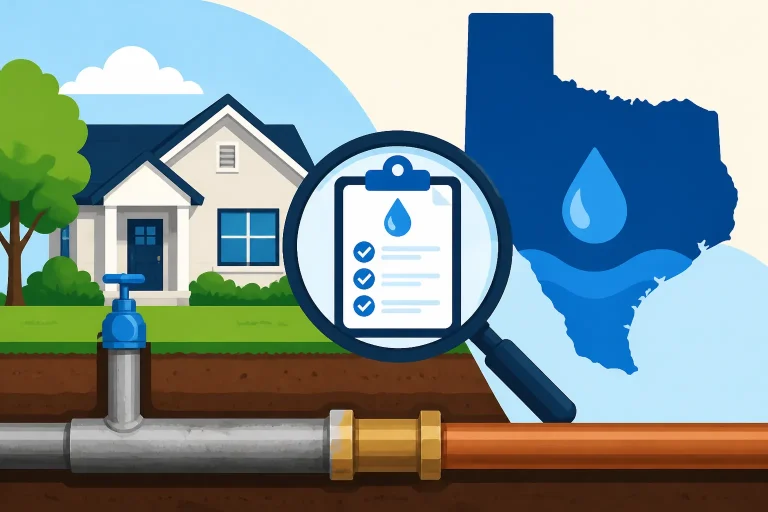
Household plumbing is another separate question. A public system can comply with drinking-water standards while a home has older plumbing, a particular fixture, or a service line that warrants investigation. A utility report does not inspect every private pipe in a house. For lead concerns, distinguish between the public service line record and plumbing on the property, and consider a test designed for the concern you are investigating. Lead Service Lines in Texas: Looking Up What’s on File for Your Home and No Lead Service Line Doesn’t Mean No Lead: Texas Plumbing Risks explain why a service-line record is not the full picture.
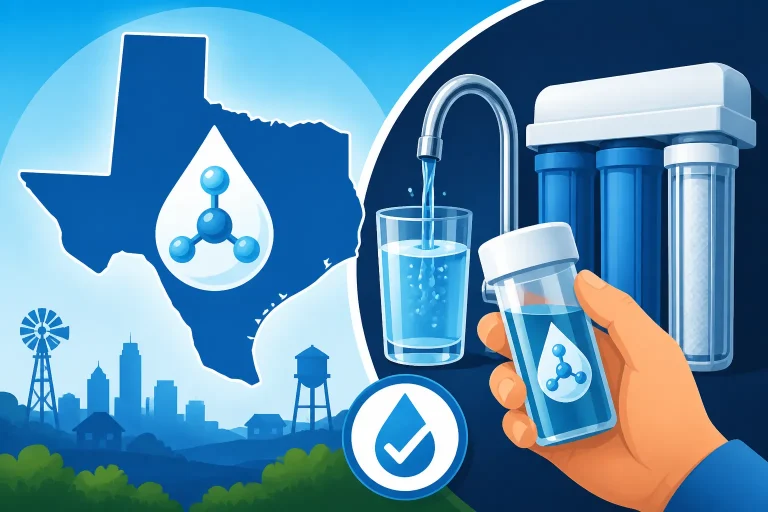
A test of your own tap can add information when there is a specific reason to investigate, such as a persistent change at one outlet, a concern about a building’s plumbing, or a need for results that system records do not provide. Choose the test based on the question you want answered, and use a qualified laboratory or a sampling process appropriate to the analyte. A general-purpose home device or a single measurement may not identify all relevant contaminants. Getting Water Tested in Texas: Labs, Costs and Sampling covers how to approach testing.
Respond to taste, odor, color, or pressure changes
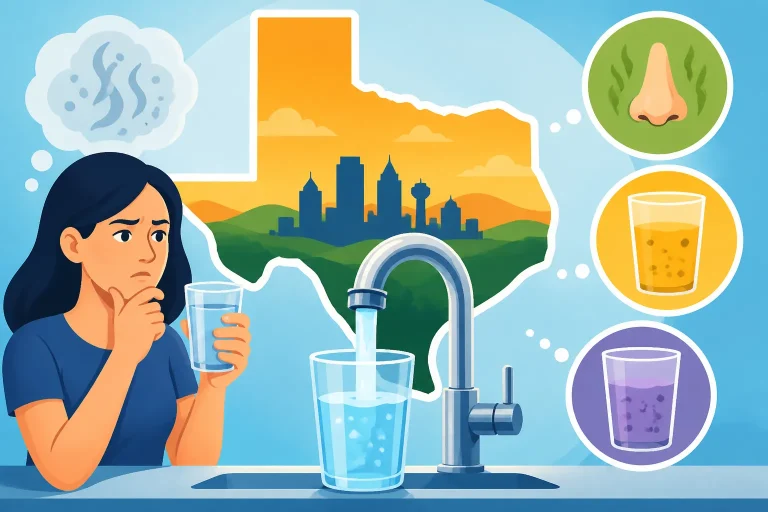
A sudden change in water deserves attention, but appearance and taste are not dependable substitutes for records or testing. Clear water is not proof that every contaminant is absent, and an unusual taste does not by itself prove the water is unsafe. The useful first step is to work out whether the change is limited to one faucet, affects the whole home, or is also being reported by neighbors.
If the change appears at only one faucet, compare it with other cold-water taps in the home. A difference isolated to a fixture can point to a local plumbing or fixture issue, but it is not a diagnosis. If the change occurs throughout the home or across the neighborhood, contact the provider and check for current notices. Use Utility Water or Your Own Plumbing? Tracing a Texas Tap Problem to organize those checks.
For an unusual taste, smell, or color:
- Note when it began and whether it is constant or intermittent.
- Check whether it occurs at one outlet or several.
- Compare cold water with hot water, without tasting water you suspect may be unsafe.
- Look for a current notice or service update from the provider.
- Describe the location and symptoms clearly when you contact the utility.
- Ask whether the provider has received similar reports and whether it recommends any next steps.
Do not assume that a common taste or odor is harmless without checking, and do not treat it as proof of contamination either. A provider can help distinguish a system-wide change from an issue that appears limited to your property. For likely sources and sensible next steps, see Odd Taste, Smell or Color in Texas Tap Water: Health Risk or Nuisance? and When to Call Your Texas Utility About Sudden Water Changes.
Low pressure or a sudden change in pressure can also be worth reporting, especially if it affects more than one fixture or occurs alongside a boil-water advisory or other notice. Avoid drawing conclusions about the cause from pressure alone. Contact the provider, describe what is happening, and ask whether there is a service issue affecting your area.
If a provider recommends flushing a tap or taking another step, follow its specific instructions. Do not improvise a treatment method, and do not assume that a household filter makes water safe during an official advisory. Filters are designed for particular contaminants and conditions, and performance depends on the exact product and its use. For treatment choices, first identify the issue and then check whether a product is certified for the contaminant shown by an appropriate water test. A Homeowner’s Guide to Water Filtration Systems in Texas explains how to match treatment to a defined need.
Decide whether a home test or treatment makes sense
A home test is most useful when it answers a specific question that system records cannot resolve. Before arranging one, identify the concern, the location to be sampled, and whether the sample needs to reflect water from the utility, a household faucet, or a particular part of the plumbing. The right sampling plan depends on the contaminant being tested; collecting or handling a sample incorrectly can make results difficult to interpret.
If the concern is a private well, public water-system records do not describe that well’s water. The owner is responsible for arranging appropriate testing and deciding what follow-up is needed. See How Often Texas Private Wells Need Testing and Where to Go for well-specific considerations. If the home is on a public system but you suspect a plumbing-related issue, make clear to the lab or utility that you want to understand the water at a particular tap.
A useful testing sequence is:
- Check the provider’s current notices and available results first.
- Define the question, such as whether a particular contaminant is present at a household tap.
- Ask a qualified laboratory or the utility what sample location and handling procedure fit that question.
- Keep a copy of the report and note where and when the sample was collected.
- Ask the lab or a qualified professional to explain results you cannot interpret.
- Compare any treatment proposal with the test result and the specific contaminant it is designed to reduce.
Buying a filter before testing can be an expensive way to address the wrong problem. Different devices are designed to reduce different substances, and not every unit is certified for every contaminant or for every model of cartridge. Check the certification for the exact product and confirm that it covers the contaminant shown in your results. A device should not be presented as preventing, treating, or curing a disease.
Treatment also has trade-offs. A point-of-use device treats water at a particular outlet; a whole-house system treats water entering the home and may affect multiple uses. Installation, maintenance, replacement parts, and compatibility with the plumbing all matter. A filter that improves taste may not address a different contaminant, and a water softener is not a universal contaminant-removal system. If you decide a device may be appropriate, Certified Filters in Texas: NSF, WQA and What the Seals Cover and Matching Home Water Treatment to the Problem in Texas can help you evaluate the match.
For a health question, do not try to infer individual risk from a filter label, taste, or a single system result. Ask your local health department or a medical professional for guidance. For a water-quality or service question, contact the utility or laboratory through its official website and provide the relevant report or sample details.
A practical routine for judging your own system
You do not need to interpret every technical record to make a sound first assessment. A focused routine can show whether the supply is identified, whether a notice applies, and whether the available evidence answers your question.
- Confirm the provider. Use your bill, lease, or provider’s confirmation to identify the system serving your address.
- Check for current information. Review the provider’s official website and the Texas Drinking Water Viewer for relevant results, schedules, violations, and notices.
- Read the annual report. Confirm that the CCR matches your system and reporting period. Review its detected contaminants, reported levels, compliance explanations, and source information.
- Separate system information from home-specific concerns. A system report may not describe a particular faucet, service line, or private well.
- Report changes. Contact the utility if water changes suddenly, a notice’s scope is unclear, or pressure changes affect your home.
- Test for a defined reason. If the records do not answer a specific question, choose a suitable test and follow the lab’s sampling instructions.
- Treat only when the evidence supports it. Match a treatment unit to the test result and verify the certification claim for the exact model.
- Ask the right person about health. For questions about health effects, contact your local health department or a medical professional.
This routine helps avoid two common mistakes: assuming that a statewide statement settles a household-specific concern, and assuming that an unusual taste or detected result proves a health hazard. The reliable approach is to identify the system, check current notices, read the relevant report, and investigate the home itself when the concern is about plumbing or a particular tap.
If you cannot find a report or determine whether a notice applies, contact the provider and ask for a direct answer about your address. If you still need independent information, ask a qualified laboratory about a sample designed to answer your question. Keep the system record, notice, and any test result together so that each piece of information can be considered in context.
Frequently Asked Questions
Is Texas tap water generally regulated?
According to TCEQ, all Texas public water systems are required to adhere to the federal drinking water standards described by the agency. That requirement is a useful baseline, but a system-level record does not prove the condition of every household tap or private well.
Where can I check my water system’s results?
The Texas Drinking Water Viewer is open to the public. According to TCEQ, it provides Sample results, schedules, violations, and public notice due dates. Confirm that the system shown is the one serving your address.
Does a detected contaminant mean the water is unsafe?
Not by itself. Read the reported level and the report’s explanation, including any comparison standard, compliance information, and public notice. If the result raises a health question, ask your local health department or a medical professional.
Does the CCR test the water at my kitchen tap?
A CCR is a report for a community water system, not necessarily a test of your specific faucet. If you have a concern about household plumbing or a particular tap, ask the utility or a qualified laboratory whether a targeted sample would help.
Should I buy a filter if I dislike the taste?
First check whether the change is limited to one faucet, affects the whole home, or coincides with a utility notice. If you consider treatment, match the exact device’s certification to a defined water-quality concern rather than assuming a taste filter addresses every contaminant.
Sources
- Texas Commission on Environmental Quality — Choosing Home Water Treatment – Texas Commission on Environmental Quality – www.tceq.texas.gov (checked November 13, 2026)
- Texas Commission on Environmental Quality — Drinking Water Lead and Copper Program – Texas Commission on Environmental Quality – www.tceq.texas.gov (checked November 13, 2026)
- Texas Commission on Environmental Quality — Chemicals in Drinking Water – Texas Commission on Environmental Quality – www.tceq.texas.gov (checked November 13, 2026)
Disclaimer
This article is for general informational purposes only and does not constitute professional advice. Laws, prices and regulations vary by location and change over time. Consult a qualified professional for guidance on your specific situation. Texas Water Guide is not a government agency or water utility and is not affiliated with any public water system.